Zoey all the way!

Monday, May 24, 2010

Sorry!

I lied. Sorry. I thought we would be able to keep our display boards. So now I can't put the cases on here because I have no clue how to get them. So I'm sorry!!

Monday, May 10, 2010

Dog Abuse

My display board for 4-H is animal abuse of course. It has 5 abuse cases on it. They are all very sad. I'm going to try to talk about them. But not today. I don't have time because I have to go to 4-H day! It's going to be so much fun! Just wait for the 5 cases in the days to come.

Monday, April 12, 2010

Animal Abusers

I think animal abusers don't go to jail long enough. Micheal Vick just got out and went for how long, A few months!!!!! And now hes acting all sorry and helping the Humane Society!! Whatever he doesn't mean it!! Hes just trying to make himself look good!! Now back on the topic of jail, they should go to jail at least 5 years. If you have a different opinion, comment or email me!!!

Monday, March 8, 2010

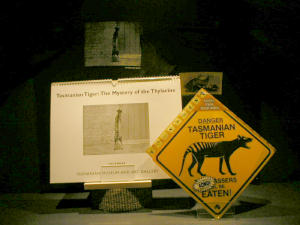
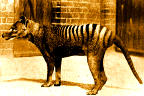
This is a very interesting animal call an Australian Thylacine or Tasmanian Tiger

Research of the
Australian Thylacine

For the past 46 years, I have been searching the Australian bush for living proof that the 'extinct' Thylacine Thylacinus cynocephalus, better known as the 'Tasmanian Tiger" - still survives on the mainland. It is an exciting search that has taken my wife Heather and I all over the country. In June 1984 we were dropped by helicopter with a TV film crew into a remote area of northern Tasmania to investigate a report that a small colony of the Thylacine existed there. The expedition drew a blank, as in the past, but the search goes on.

Australian Thylacine

University zoologists have long maintained that the 'Tasmanian tiger", or Thylacine, died out on the Australian mainland around 3,000 years ago and that the last Tasmanian specimen died in Hobart Zoo in the 1930s, yet hundreds of recent sightings reports suggest not only that some of these marsupials still linger on in the remoter areas of Tasmania, but that they continue to survive in Australia's eastern mainland wilderness areas in much larger numbers.

The reason for their demise in Tasmania is well known. Beginning last century when settlers considered them pests and hunted them because of frequent attacks on their poultry and livestock, they were soon being slaughtered for their fur. However, it is argued now that many of these poultry and stock killings were actually the work of that other, smaller, ferocious marsupial carnivore, the 'Tasmanian Devil".

Is the Thylacine Really Extinct?

It has been suggested that the Tasmanian population of Thylacines will eventually die out. This assumption is based upon the view that too few of the unfortunate creatures now survive in that island-state, with males and females so widely scattered that it is difficult for them to meet for breeding purposes.

Yet there are signs, as shown from the increasing number of sightings claims in certain years, that the Thylacine's numbers may have increased. Even so, as will be seen, the mainland Thylacine population may be in a far better situation, with small breeding groups scattered over a vast area of the eastern mountain ranges.The fossil record of the Thylacine now stretches back at least two million years.

They roamed a landmass which in those times, during the last great ice age, included New Guinea as well as Tasmania. According to anthropologists, the introduction by Stone Age people of the dingo from South East Asia around 8,000 years ago, coupled with Aboriginal hunting activities, reduced Thylacine numbers on the mainland long before European arrival, by which time they claim it was already extinct here.

The final flooding of Bass Strait, around 12,000 years ago, isolated the Tasmanian Thylacine population until European settlement. Regardless of the accepted scientific view that these creatures are now totally extinct, particularly on the mainland, we shall now examine evidence to the contrary, beginning with one of their favourite haunts, the Blue Mountains of New South Wales.

In television interviews I am often asked what drives me to continue my search, year after year, for creatures regarded by university zoologists as long extinct. The interviewers ask why I believe the Thylacine still survives in mainland Australia.

My Answer Is Threefold.

First, there are a large number of eyewitness claims of sightings of often large, striped, dog-like animals, possibly Thylacines, coming from over a wide area of the rugged eastern Australian mountain ranges from far north Queensland through New South Wales to eastern Victoria.

Second, plaster casts have been taken of tracks found on the mainland which compare with others from Tasmania, leaving no doubt as to the animal's identity.

Third, I have had my own sighting of a Thylacine. On Tuesday 22nd February 1972 at 10.15 pm, a female companion and I were driving along the Great Western Highway just south of Blackheath toward Katoomba in the Blue Mountains of New South Wales. As we approached the left-hand turnoff to Evans Lookout, at the corner of the local council water catchment fence which encloses a vast area of dense scrubland, we saw in the glare of the car's headlights a strange animal.

It was dog-like and about the size of a full-grown Alsatian, with fawn coloured body fur and a row of blackish body stripes extending barrel-wise from mid-back to tail-rump. The animal had been walking across the highway (usually quiet thereabouts on a weeknight) when we saw it, forcing us to brake quickly. By this time our car was but a few feet from the animal which just stood there staring at our vehicle, mesmerised by the headlights' glare. In the few seconds before the animal dashed off the road into the darkness of the catchment scrub, we were able to get a good look at it.

Apart from its size, it was greyhound-like in appearance with narrowing flanks, its body sloping downward to a long, thin tail which followed the slope of the back and seemed kangaroo-like in that it did not appear to wag. The shape of the head, legs and body was unmistakable. It was a Tasmanian Tiger. Its physical appearance matched that of stuffed specimens preserved in government museums.

The creature had escaped into scrubland which extends eastward to a gully which drops down into the Grose Valley-where sightings of Thylacine-type animals continue to be reported by campers and bushwalkers to the present day.


Thylacine Timeline
End of Extinction

1936: Last known Thylacine (Tasmanian Tiger) dies in Hobart Zoo.

1986: Thylacine (Tasmanian Tiger-Tasmanian Wolf) Officially declared Extinct.

1999: Rheuben Griffiths Trust launched due to fund cloning research for the Thylacine.

2000: Australian Museum extracts DNA from the preserved Thylacine pup.

2002: DNA bought back to life.

2002-2004: Sequencing of the Thylacine genome to begin.

2004: Identification of suitable host expected.

2005-10: Attempts at fertilisation with host.

2010: Potential birth of first cloned Thylacine.

FACTS

2006 - The DNA was so fragmented that no cloning could take place.

2007 - Sightings continue Australia-wide.

Sydney Thylacine ExhibitionThylacine Exhibition
Tasmanian ThylacineThylacine Photographs
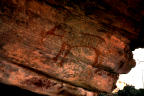
Thylacine Cave ArtThylacine - Cave Art

Monday, February 22, 2010

Platypuses

I love platypuses!! A lot of people don't know about them so here is some information.


Map: Platypus range

Platypus Range

Fast Facts

Type:
Mammal
Diet:
Carnivore
Size:
Head and body, 15 in (38 cm); Tail, 5 in (13 cm)
Weight:
3 lbs (1.4 kg)
Size relative to a 6-ft (2-m) man:
Illustration: Platypus compared with adult man

The platypus is among nature's most unlikely animals. In fact, the first scientists to examine a specimen believed they were the victims of a hoax. The animal is best described as a hodgepodge of more familiar species: the duck (bill and webbed feet), beaver (tail), and otter (body and fur). Males are also venomous. They have sharp stingers on the heels of their rear feet and can use them to deliver a strong toxic blow to any foe.

Platypuses hunt underwater, where they swim gracefully by paddling with their front webbed feet and steering with their hind feet and beaver like tail. Folds of skin cover their eyes and ears to prevent water from entering, and the nostrils close with a watertight seal. In this posture, a platypus can remain submerged for a minute or two and employ its sensitive bill to find food.

These Australian mammals are bottom feeders. They scoop up insects and larvae, shellfish, and worms in their bill along with bits of gravel and mud from the bottom. All this material is stored in cheek pouches and, at the surface, mashed for consumption. Platypuses do not have teeth, so the bits of gravel help them to "chew" their meal.

On land, platypuses move a bit more awkwardly. However, the webbing on their feet retracts to expose individual nails and allow the creatures to run. Platypuses use their nails and feet to construct dirt burrows at the water's edge.

Platypus reproduction is nearly unique. It is one of only two mammals (the echidna is the other) that lay eggs.

Females seal themselves inside one of the burrow's chambers to lay their eggs. A mother typically produces one or two eggs and keeps them warm by holding them between her body and her tail. The eggs hatch in about ten days, but platypus infants are the size of lima beans and totally helpless. Females nurse their young for three to four months until the babies can swim on their own.

Sunday, January 31, 2010

Aid's Bubble

You should go to my friend's blog!! It's aidsbubble.blogspot.com!! GO THERE!! Please!!

Tuesday, January 5, 2010

Blog Status

Kayla Garrett is at home happy that school is out........ Again!!